Summary
In this lecture, we'll cover:
- The local and global reference frames used for a shell element,
- The Reissner–Mindlin assumption for plate deformation and transverse shear,
- How the displacement of the middle plane is modelled in the local - and - planes,
- How membrane displacements are added to the plate model to form a shell displacement model,
- How the shell element displacement vector is written in terms of five kinematic variables.
The lecture focuses on building a geometric model for how a shell element deforms under load. We begin by restating the Reissner–Mindlin plate assumption: a normal to the middle plane remains straight but is allowed to rotate relative to the middle plane, which lets us approximate transverse shear deformation. Using this idea, we derive the displacement components in the local directions, first for bending only and then with the addition of membrane motion. In the shell model, the total in-plane displacements and are made up of membrane terms plus flexural terms, while the out-of-plane displacement remains the transverse deflection of the middle surface.
We then combine these pieces into the full kinematic description of a shell element. In our model, the displacement at any point is captured by five variables: the three mid-surface displacements and the two rotations . The key idea is that shell deformation is treated as a modest extension of the plate formulation: we keep the bending and shear description from Reissner–Mindlin theory, and add membrane displacement so that the model can represent both in-plane and out-of-plane behaviour.
Next up
In the next lecture, we will differentiate this displacement field to obtain the strain expressions, splitting them into membrane, bending, and transverse shear components.
Tags
Please log in or enroll to continue
If you've already enrolled, please log in to continue.
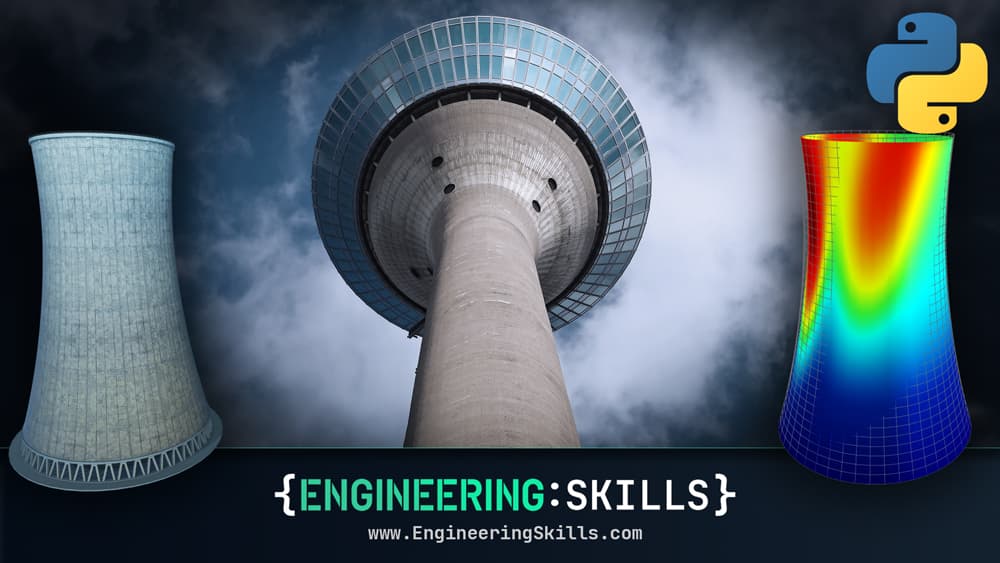
Finite Element Analysis of Plate and Shell Structures: Part 2 - Shells
Expanding from plate to shell elements - build a workflow that unlocks the behaviour of 3D shell structures
After completing this course...
- You will understand how we make the leap from Reissner-Mindlin plate elements to shell elements and what extra modelling fidelity that provides.
- You will be comfortable using a combination of GMSH and the open-source 3D modelling software, Blender, to generate custom finite element meshes.
- You will be able to use OpenSeesPy to model shell structures, as an alternative to your own custom finite element solver.
- You will have a much greater understanding of what commercial finite element packages are doing, behind the UI, allowing you to authoritatively interrogate their results.