Summary
In this section, we'll cover:
- How to move from a local element reference frame to a common global reference frame,
- How to define and use the transformation matrix,
- How to define the local element reference frame in a couple of different ways,
- How to code these ideas up and visualise them with 3D plots,
- How to build the element transformation matrix from the element axes.
- How to use the transformation matrix to convert the local element stiffness matrix into a global element stiffness matrix.
In this section, we will take the next step after establishing the local element stiffness matrix by working out how to express forces, stiffnesses and displacements in a shared global frame. To do that, we first revisit the transformation matrix carefully and build up a clear understanding of what it does and how it is defined. We then consider different ways of defining the local element reference frame.
Once we have the element axes and transformation matrix in place, we will use them to convert the local element stiffness matrix from the previous section into a global element stiffness matrix. This global form is the one we need before we can combine individual element contributions into the overall structure stiffness matrix in the next section of the course.
Next up
In the next lecture, we will define the transformation matrix. We will also see how to use the transformation matrix to transform quantities defined in a local element reference frame into quantities defined in a global reference frame.
Tags
Please log in or enroll to continue
If you've already enrolled, please log in to continue.
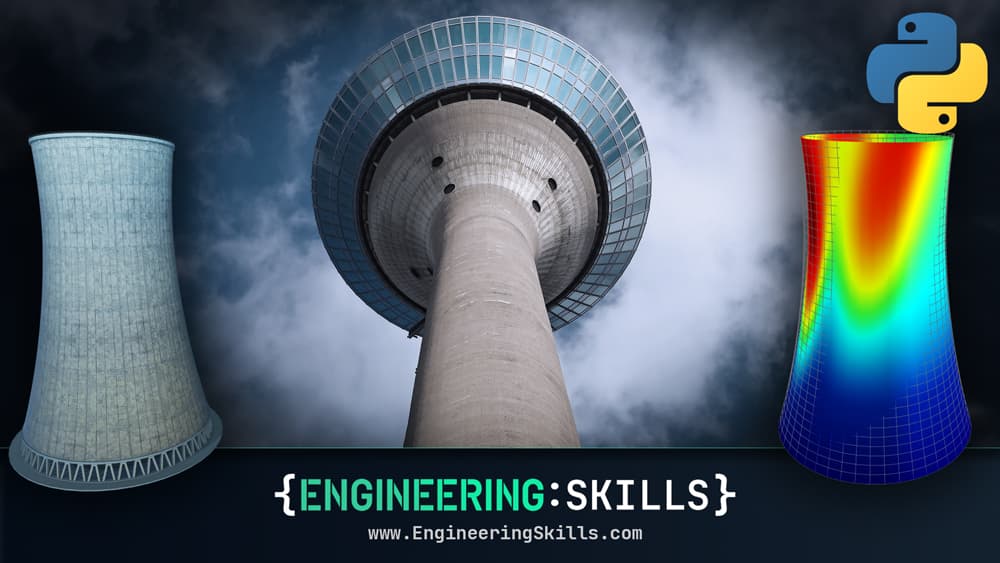
Finite Element Analysis of Plate and Shell Structures: Part 2 - Shells
Expanding from plate to shell elements - build a workflow that unlocks the behaviour of 3D shell structures
After completing this course...
- You will understand how we make the leap from Reissner-Mindlin plate elements to shell elements and what extra modelling fidelity that provides.
- You will be comfortable using a combination of GMSH and the open-source 3D modelling software, Blender, to generate custom finite element meshes.
- You will be able to use OpenSeesPy to model shell structures, as an alternative to your own custom finite element solver.
- You will have a much greater understanding of what commercial finite element packages are doing, behind the UI, allowing you to authoritatively interrogate their results.