Summary
In this lecture, we'll cover:
- The difference between plate elements and shell elements
- How plate elements resist loading through bending and shear
- How shell elements additionally develop membrane action
- How the shell element stiffness matrix is split into bending, shear and membrane contributions
- Why flat shell geometry is used instead of curved shell geometry in practice
- How a curved shell structure can be represented by discretising it into flat elements
- The local element axis system and displacement components used for shell elements
- Why the Reissner-Mindlin formulation is adopted for shell elements
In this lecture, we first distinguish plates from shells by noting that plates resist load mainly through flexure, whereas shells resist load through flexure and membrane action. We therefore see that a shell element stiffness matrix contains bending, shear and membrane terms.
We then focus on how to model shell geometry in a practical finite element setting. Rather than using curved shell elements, which lead to a more complicated and less practical mathematical formulation, we choose flat shell elements and represent curved structures by discretising them into many small flat faces. This gives us a simpler and widely used approach for building code, while still capturing the important behaviour of shell structures.
Next up
In the next lecture, we will develop the displacement field for a flat shell element which describes how the element deforms under load.
Tags
Please log in or enroll to continue
If you've already enrolled, please log in to continue.
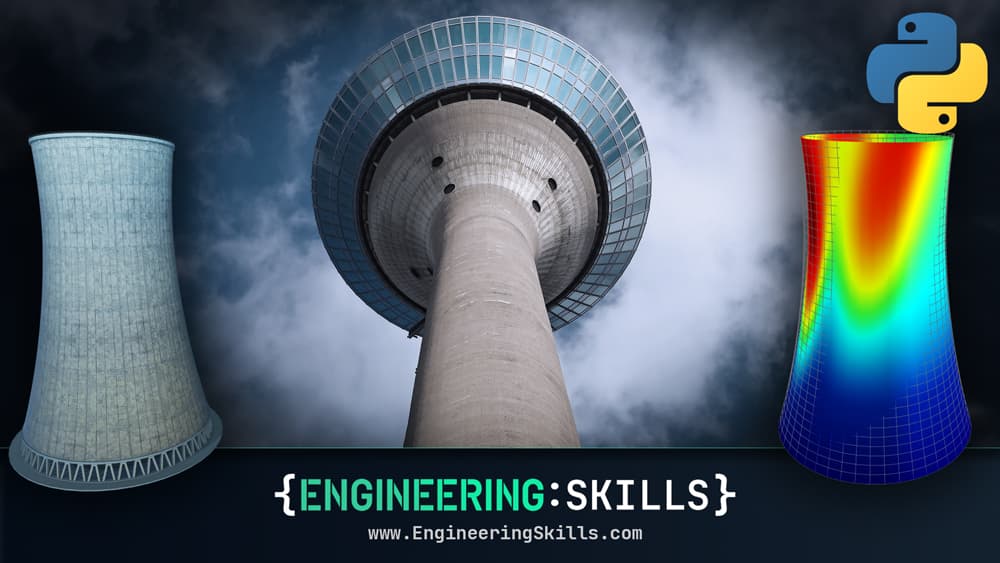
Finite Element Analysis of Plate and Shell Structures: Part 2 - Shells
Expanding from plate to shell elements - build a workflow that unlocks the behaviour of 3D shell structures
After completing this course...
- You will understand how we make the leap from Reissner-Mindlin plate elements to shell elements and what extra modelling fidelity that provides.
- You will be comfortable using a combination of GMSH and the open-source 3D modelling software, Blender, to generate custom finite element meshes.
- You will be able to use OpenSeesPy to model shell structures, as an alternative to your own custom finite element solver.
- You will have a much greater understanding of what commercial finite element packages are doing, behind the UI, allowing you to authoritatively interrogate their results.