Summary
In this lecture, we will cover the following:
- We highlight the importance of an invertible stiffness matrix,
- We define stiffness matrix singularity in structural analysis terms,
- We connect null-space vectors to zero-energy displacement modes,
- We will distinguish rigid body modes from spurious zero-energy modes,
- We relate unrestrained drilling rotations to rank deficiency.
We start with the basic structural relationship between force, stiffness, and displacement. Solving the model requires the stiffness matrix to be invertible; if the matrix is singular, the displacement solution cannot be obtained. The lecture explains singularity in physical terms by describing a non-zero displacement pattern that produces no internal force.
We then learn that these displacement patterns are null-space vectors, and that each independent null-space vector corresponds to a zero-energy mode. Some zero-energy modes are expected, such as rigid body translations and rotations before restraints are applied. The problematic cases are spurious modes that remain after the structure is restrained, so we focus on unresisted drilling rotations at shared nodes as the relevant mechanism.
Next up
In the next lecture, we will apply this understanding to our specific shell structure that produced the unexpected solver behaviour.
Tags
Please log in or enroll to continue
If you've already enrolled, please log in to continue.
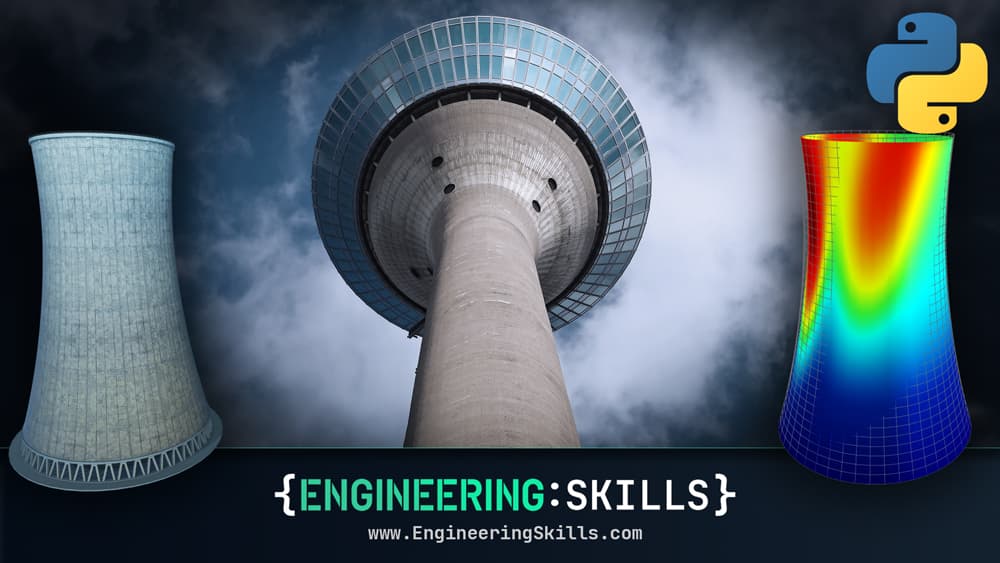
Finite Element Analysis of Plate and Shell Structures: Part 2 - Shells
Expanding from plate to shell elements - build a workflow that unlocks the behaviour of 3D shell structures
After completing this course...
- You will understand how we make the leap from Reissner-Mindlin plate elements to shell elements and what extra modelling fidelity that provides.
- You will be comfortable using a combination of GMSH and the open-source 3D modelling software, Blender, to generate custom finite element meshes.
- You will be able to use OpenSeesPy to model shell structures, as an alternative to your own custom finite element solver.
- You will have a much greater understanding of what commercial finite element packages are doing, behind the UI, allowing you to authoritatively interrogate their results.