Summary
In this lecture, we will cover the following:
- How to express the equivalent nodal force vector as a double integral over the element area,
- How to evaluate that integral numerically using Gauss quadrature,
- How to build a function that returns the local equivalent nodal force vector for an element,
- How to map gravity from the global frame into the local frame for each element and assemble the global force vector.
To solve our system, we need a global force vector, and in this lecture we build that vector based on the self-weight of the shell. We begin with a quick refresher on the equation for the local element force vector. We approximate this double-integral using the same Gauss quadrature scheme we used for the element stiffness matrix.
Then we package all of this into a function that takes in the local and coordinates of an element and the local distributed force vector . Inside the function, we loop over the Gauss sampling points and evaluate a contribution to the equivalent nodal force vector for the element. After accumulating the complete equivalent nodal force vector we can return it from the helper function. With our function ready, we then iterate over every element and assemble the global force vector for the structure.
Next up
With our stiffness matrix and force vector both in place, we now have everything we need to actually solve the system. In the next lecture, we'll do just that. Then we'll compute the nodal displacements and reactions, confirm vertical force equilibrium, and identify the maximum displacement in the structure.
Tags
Please log in or enroll to continue
If you've already enrolled, please log in to continue.
Finite Element Analysis of Plate and Shell Structures: Part 2 - Shells
Expanding from plate to shell elements - build a workflow that unlocks the behaviour of 3D shell structures
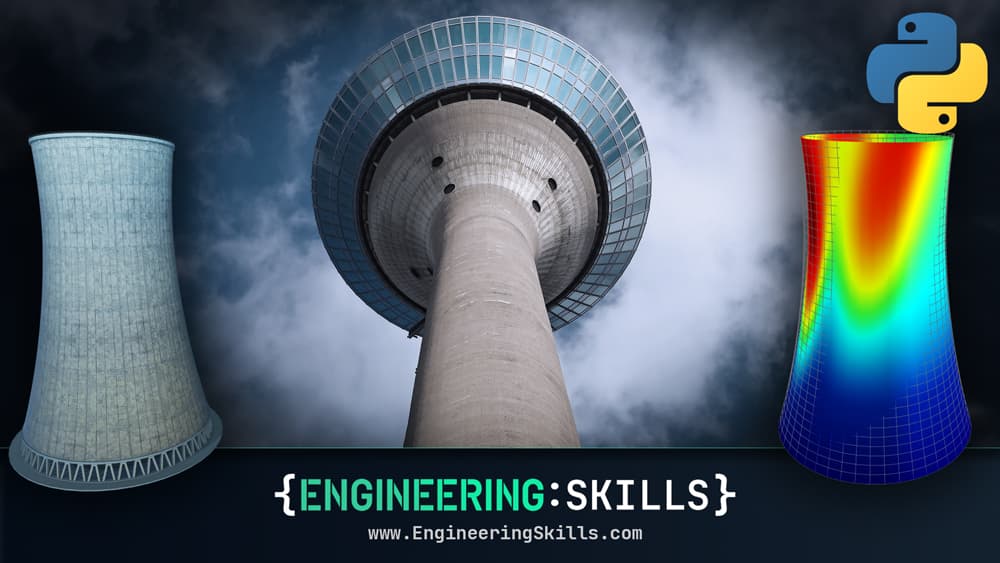
After completing this course...
- You will understand how we make the leap from Reissner-Mindlin plate elements to shell elements and what extra modelling fidelity that provides.
- You will be comfortable using a combination of GMSH and the open-source 3D modelling software, Blender, to generate custom finite element meshes.
- You will be able to use OpenSeesPy to model shell structures, as an alternative to your own custom finite element solver.
- You will have a much greater understanding of what commercial finite element packages are doing, behind the UI, allowing you to authoritatively interrogate their results.