Understanding Tresca and von Mises Elastic Failure Theories
![[object Object]](/_next/image?url=%2Fimages%2Fauthors%2Fjulian_haudek.jpg&w=256&q=75)
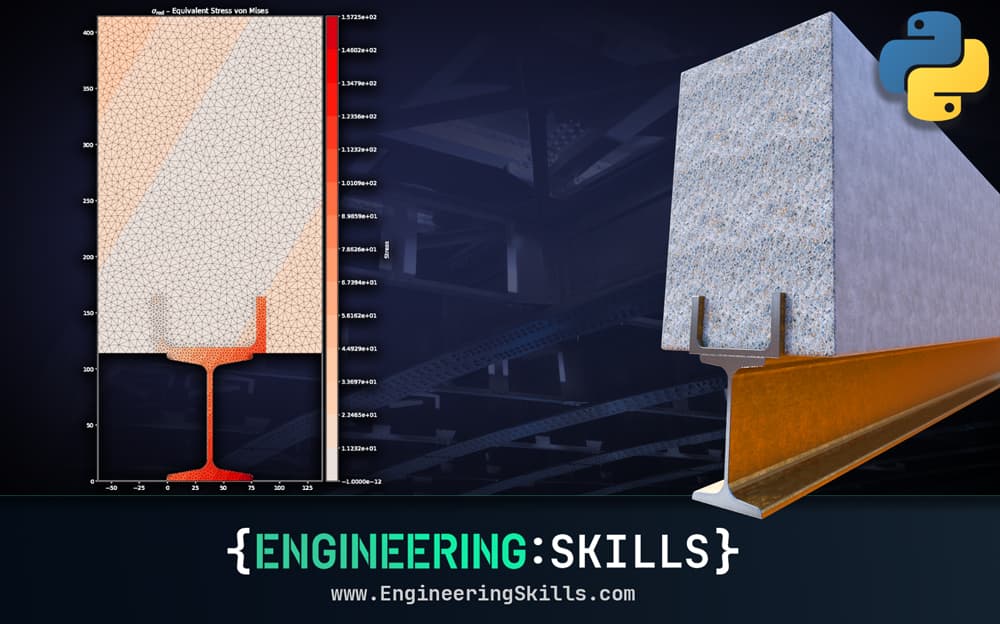
As engineers, we see the term von Mises in pretty much every analysis software we open up, and I bet there are quite a few engineers out there who don’t fully understand what exactly it refers to…well, after completing this tutorial, you definitely won’t be one of them!
In this tutorial, Julian Haudek provides an excellent A-Z of Tresca and von Mises elastic failure theories. Here’s a breakdown...
Tutorial breakdown
📍 1.0 What does it mean for a material to fail?
We start by addressing a simple question: What is failure? Since our main focus is elastic failure theories, this is a logical place to get the brain warmed up!
📍 2.0 Recap of material strength fundamentals
We can’t understand Tresca and von Mises without understanding some fundamentals about how we model material behaviour. For most, this will be a review of familiar material. But, it will be helpful for those who haven’t picked up a mechanics of materials textbook in a while!
📍 3.0 Failure theories – turning complex stress into a simple answer
In section 3, we introduce the concept of a failure theory - it’s a simple idea but not one we’re routinely used to seeing…how this theory or that predicts structural failure. Again, this is essential groundwork for what follows.
📍 4.0 Tresca maximum shear stress failure theory
Now we can start to get to the heart of the issue - the failure theories themselves. We start by developing Tresca first, from the basic idea to a concise mathematical presentation of the theory…it’s not as difficult as it may sound!
📍 5.0 von Mises distortion energy failure theory
With Tresca covered and the understanding of what a failure theory actually is, now clear, working our way through von Mises is quite straightforward. Again, the aim is to balance theoretical development with an intuition for what von Mises stress actually is.
📍 6.0 Comparing Tresca and von Mises stress
A logical next step is to compare the two theories - that’s the aim of section 6. We’ll briefly outline the differences between the two and identify which one yields more conservative results!
📍 7.0 Worked Example – Putting the theory into action
As with any good engineering tutorial, it all starts to make much more sense when we plug some numbers into an example. In section 7, we’ll evaluate the equivalent Tresca and von Mises stresses in a relatively simple numerical example.
📍 8.0 Validation with Python’s sectionproperties library
The calculations we completed in section 7 start to feel very tedious once you’ve done them a couple of times. So, in section 8, we introduce the open-source Python library, sectionproperties. This allows us to dramatically speed up our geometric and stress analysis of the section. There’s no harm in using these tools…once we understand the underlying theory!
📍 9.0 Composite Section – Practical Use Case
In the previous section, we used sectionproperties to validate the manual calculations we completed in section 7. This was a pretty simple problem and didn’t really push sectionproperties too hard. So, in section 9, we tackle a more involved example…one that would be a real headache if we had to do it by hand!
📍 10.0 Final thoughts and wrapping up
Julian wraps things up in section 10 with some closing comments
I hope you enjoy the tutorial - please share this with anyone else you think might also find it helpful!
📂 Make sure to download the Jupyter Notebook (linked above) to run locally as you read through the tutorial.

1.0 What does it mean for a material to fail?
What does it actually mean when we say that a material has failed? Is it when it breaks apart? When it deforms permanently? Or simply when it no longer performs its intended function? The truth is failure isn't always visible or even obvious.
In reality, components develop complex, multi-axial stress states in response to external loading. Over time or under increasing load, these internal stresses can exceed the material’s capacity. Sometimes the component bends, sometimes it cracks and sometimes it simply deforms in a way that makes it unfit for purpose.
In this tutorial, we’ll introduce elastic failure theories which help us boil down complex stress states into a simple measure of how close a material is to failure. By the end you’ll understand the Tresca and von Mises failure theories and their application. We’ll work through some practical examples and even venture into some Python scripting to help speed up common stress analysis tasks.
Engineering tutorials,
written by an engineer — not a model.
Read the rest, download the resources and unlock the full archive. This is independent, human-crafted engineering content. An Essentials Membership gets you access to all member-only tutorials and helps keep the lights on for a learning platform built by engineers, for engineers.
Essentials Membership
- Instant access to the full archive
- 28-day refund, no questions
- Cancel anytime
- Your card and subscription are handled by Stripe
Already a member? Log in
Featured Tutorials and Guides
If you found this tutorial helpful, you might enjoy some of these other tutorials.
A Pynite Crash Course - Open Source Finite Element Modelling for Structural Engineers
Part 1 - Get hands-on with V1.0 of this exciting new Python FEA library

Dan Ki
Steel Truss Design to Eurocode 3
Learn how to design one of the most common structural forms - the steel truss

Callum Wilson