Pushover analysis of RC frames subject to monotonic loading with OpenSeesPy
![[object Object]](/_next/image?url=%2Fimages%2Fauthors%2Fhisham_al_hanoun.jpg&w=256&q=75)

I’m really pleased to introduce our newest guest contributor, Dr. Ing. Muhammad Hisham AL Hanoun. Dr Al Hanoun is a researcher at Bauhaus University Weimar, where his focus is on understanding the interaction between RC frames and masonry infills.
In this tutorial, he walks us through a comparative pushover analysis of a reinforced concrete frame with and without unreinforced masonry infill panels. This analysis reveals the enhanced stiffness provided by the infill panels - something we intuitively expect but can now model and quantify.
This tutorial also provides an excellent example of how to perform nonlinear pushover analysis using OpenSeesPy, not to mention the modelling of reinforced concrete sections with OpenSeesPy. The methods demonstrated are highly relevant and will no doubt be of use elsewhere in your work.
📂 The code developed for this tutorial is quite extensive, so, for brevity, many of the helper functions are not shown in full here. To see the full code, make sure to download the Jupyter Notebook (linked above).
This tutorial, combined with the Jupyter Notebook really is a valuable demonstration of a complex (well-documented) OpenSeesPy workflow, not an easy thing to come by online!
Enjoy!

Unreinforced masonry (URM) infill walls, commonly used as partition walls in reinforced concrete (RC) frame structures, are often considered non-structural. However, the presence of URM infill walls can significantly affect the system's in-plane stiffness, strength, and energy dissipation capacity.
Various numerical models exist to capture the behaviour of both primary and secondary structural systems, focusing on the in-plane (IP) response of RC frames with URM infill walls. In this article, a simplified analytical model is implemented using equivalent diagonal struts to represent the URM walls, while fiber-based distributed plasticity models are employed for the RC frame elements.
Numerical analyses are performed using OpenSeesPy, with uniaxial material models simulating the nonlinear behaviour of both primary and secondary components. After completing this tutorial, you will have a clear understanding of how to model the influence of URM panels in planar RC frames.
1.0 Modelling primary and secondary structural elements
1.1. Reinforced concrete frame elements
The fiber-based distributed plasticity method models inelastic behaviour by numerically integrating the response across the element's cross-section and along its deformable length.
In this approach, each structural element is typically divided into three integration points, with each point representing a fiber section composed of both steel and concrete fibers, as shown in Fig. 1.

Fig. 1. Fiber hinge model of RC frame elements.
To accurately capture the nonlinear hysteretic behaviour of each fiber, uniaxial material models are applied to the various components, such as unconfined concrete, confined concrete, and steel reinforcement, as illustrated in Fig. 2.
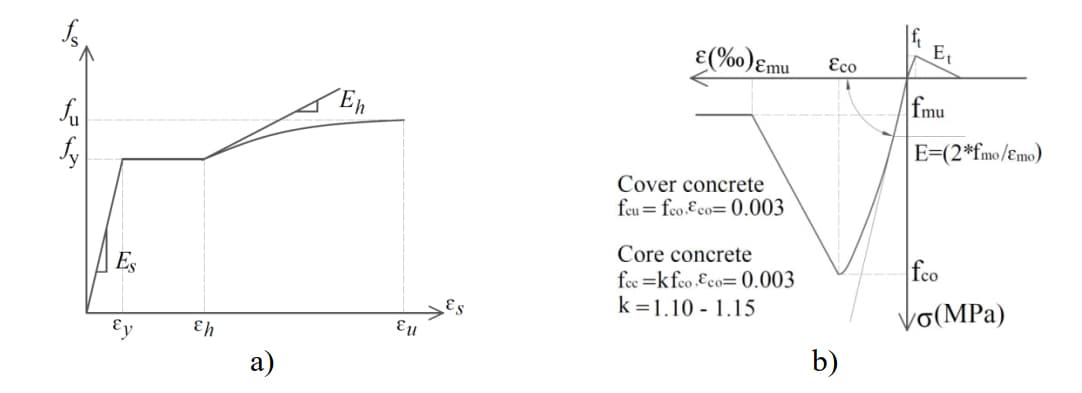
Fig. 2. Uniaxial stress-strain relationship a) steel, b) concrete.
This method also enables the fiber-based model to account for axial-moment (P-M) interaction, providing a more detailed and precise representation of the structural response under increasing monotonic loading.
1.2. Unreinforced masonry infill walls (macro-modelling)
Engineering tutorials,
written by an engineer — not a model.
Read the rest, download the resources and unlock the full archive. This is independent, human-crafted engineering content. An Essentials Membership gets you access to all member-only tutorials and helps keep the lights on for a learning platform built by engineers, for engineers.
Essentials Membership
- Instant access to the full archive
- 28-day refund, no questions
- Cancel anytime
- Your card and subscription are handled by Stripe
Already a member? Log in
Featured Tutorials and Guides
If you found this tutorial helpful, you might enjoy some of these other tutorials.
Column Buckling and Stability
Long slender structural elements in compression will typically fail due to buckling rather than direct compression. In this post we'll explore column buckling

Dr Seán Carroll