P-Delta Analysis and Geometric Non-linearity
![[object Object]](/_next/image?url=%2Fimages%2Fauthors%2Fsean_carroll.png&w=256&q=75)

In this tutorial, we’ll consider P-Delta analysis (); a form of non-linear behaviour that can lead to large magnitude sway deflections in columns. behaviour occurs in members subject to compression and it presents a particular challenge for columns within tall flexible structures. If you want to download the complete Jupyter Notebook for this tutorial, just follow the link below.
1.0 What is the P-Delta effect?
Put simply, describes the phenomenon whereby an additional or secondary moment is generated in a column due to the combination of axial load and lateral sway . This leads to non-linear structural behaviour and can result in lateral deflections far in excess of those arising from lateral loading alone. These so-called second-order deflections will induce additional stresses within the structure that may be significant and require special consideration in design.
The effect is referred to as a geometric non-linearity because it arises as a result of the deformed geometry of the structure. This is in contrast to a material non-linearity such as plastic hinge formation that arises due to the properties of the material.
2.0 Secondary moments caused by sway deflections
To flesh out the concept, consider a column segment of length subject to an axial force and undergoing a relative sway between its ends. The sway may have been caused by wind loading or inertia forces due to lateral ground motion. Regardless of how the initial sway deflection came to be, the key point is that the compression forces in the column are no longer co-linear.
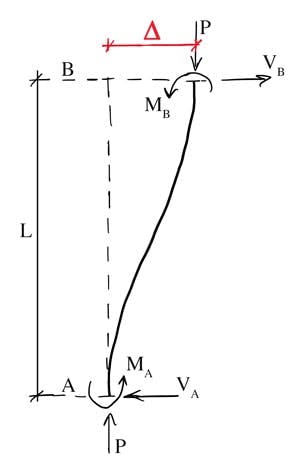
Figure 1. Column segment with length and axial force experiencing relative sway between its ends.
We can think of the axial forces, shears and moments shown above as the primary actions on the structure consistent with the first-order sway deflection, . Again, notice that the axial forces, are no longer co-linear. As a result, an extra second-order moment is developed at the base of the column,
If is a non-negligible value, we must also consider the additional secondary sway deflection caused my . Since the second-order sway deflection further increases the overall sway, leading to yet more secondary sway, we have a feedback loop that could ultimately lead to collapse.
For a tall flexible structure that may undergo significant sway from one storey to the next (storey drift) under lateral base excitation for example, this has catastrophic potential. Only when we are sure that the first-order sway deflection is negligibly small can second-order deflections be ignored.
The effect is a good example of non-linear structural behaviour arising from geometric non-linearity. The typical method of analysis requires iteration to determine the final value that the sway deflection converges on.
This value of sway deflection may be mathematically stable but represent an unsustainable physical configuration for the column. In other words, the second-order deflection may be so high that the column collapses. Ultimately the deciding factor as to whether collapse will occur is the initial sway deflection, , as this sets in motion the feedback loop that delivers the additional second-order deflection.
Since this is a non-linear structural behaviour wherein the inputs to the structural system are not linearly proportional to the outputs (the structure’s behaviour), superposition should not be used in the analysis.
Engineering tutorials,
written by an engineer — not a model.
Read the rest, download the resources and unlock the full archive. This is independent, human-crafted engineering content. An Essentials Membership gets you access to all member-only tutorials and helps keep the lights on for a learning platform built by engineers, for engineers.
Essentials Membership
- Instant access to the full archive
- 28-day refund, no questions
- Cancel anytime
- Your card and subscription are handled by Stripe
Already a member? Log in
Featured Tutorials and Guides
If you found this tutorial helpful, you might enjoy some of these other tutorials.
Column Buckling Equations
Determine column buckling equations for axially loaded column with different end conditions

Dr Seán Carroll