Calculating response factors for floor vibration and assessing performance
![[object Object]](/_next/image?url=%2Fimages%2Fauthors%2Fsean_carroll.png&w=256&q=75)
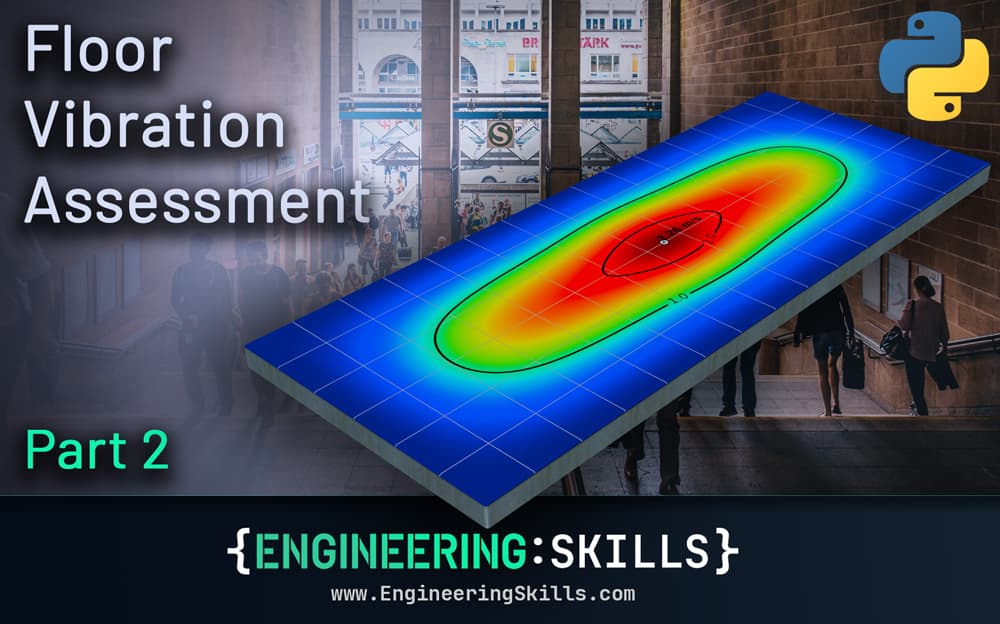
Welcome to part 2 in this occupant-induced floor vibration series. If you haven’t read part 1, do that now - it covers all of the background to the calculations we’ll be implementing in this tutorial.
Here, in part 2, our aim is to implement both the low and high-frequency analysis procedures we discussed previously. My guess is that, even after reading through part 1, you still have some questions about how the analysis workflows are implemented. We want to address these questions so that you walk away from this tutorial able do directly apply these methods to your own structures.
Make sure to download the complete Python code that goes with this tutorial (linked above). I’ve prepared a Jupyter Notebook that captures everything we’re going to cover and runs from start to finish with one click. It should be a really handy reference to look at in parallel to reading this tutorial.
We’ll cover two design examples:
- a low-frequency footbridge analysis
- and a high-frequency floorplate analysis.
The type of structure (linear footbridge versus 2D planar floorplate) only influences the determination of modal characteristics. You can apply either of the analyses demonstrated below to any ‘walking structure’ you like - once you can determine the modal properties.
Ok, with all that said, let’s dive in!
Engineering tutorials,
written by an engineer — not a model.
Read the rest, download the resources and unlock the full archive. This is independent, human-crafted engineering content. An Essentials Membership gets you access to all member-only tutorials and helps keep the lights on for a learning platform built by engineers, for engineers.
Essentials Membership
- Instant access to the full archive
- 28-day refund, no questions
- Cancel anytime
- Your card and subscription are handled by Stripe
Already a member? Log in
Featured Tutorials and Guides
If you found this tutorial helpful, you might enjoy some of these other tutorials.

Strength Design of Singly-Reinforced Concrete Beams using ACI 318-14
A guide to ACI 318-14 - Building Code Requirements for Structural Concrete

Dan Ki
An Introduction to the ETABS Python API - Automate Repetitive Analysis Tasks
Using Python to interact with your ETABS models for greater speed and efficiency.

Hakan Keskin
Column Buckling Equations
Determine column buckling equations for axially loaded column with different end conditions

Dr Seán Carroll