The Structural Behaviour Course
A roadmap for understanding structural behaviour, without a computer
Get notified when we launch 🚀
- You will be able to quickly sketch shear force, bending moment, axial force and deflected shape diagrams for 2D beam and frame structures.
- You will develop a variety of tools, beyond static equilibrium, for analysing and approximating indeterminate structures, including compatibility, symmetry and fictitious hinges.
- You will understand the links between loading, shear, moment and deflected shape diagrams, which allow you to use each one to predict the next.
- You will understand determinacy and stability, the limits of our analysis techniques and how hinge releases influence this.
We cover a lot of interesting and relatively complex analysis techniques on EngineeringSkills. These are valuable tools to have at your disposal, although some will see more use than others in a typical design office.
But one skill you’ll return to throughout your career is the ability to look at a structure, assess its loading and sketch the diagrams that describe its behaviour:
- the axial force diagram
- the shear force diagram
- the bending moment diagram
- the deflected shape
Together, these diagrams tell you a great deal about how a structure carries load. They help you identify where the critical actions occur, understand how different members interact and anticipate how the structure will deform. Being able to sketch them reliably is one of the most useful practical skills a civil or structural engineer can develop.
For graduates and experienced engineers alike
The difficulty is that these skills need practice. If it’s been a while since you picked up a pencil and worked through the behaviour of a beam or frame, you might find the process more challenging than you expected. You may remember the individual principles, yet struggle to bring them together to build a convincing picture of what the structure is doing.
For many graduates, the ability to reliably analyse a structure from first principles just isn’t where it should be. Unfortunately, the modern undergraduate curriculum is constantly being squeezed, and this can come at the expense of the time needed to build a strong understanding of structural behaviour.
For experienced engineers, the issue is often lack of use. Years spent managing projects, delegating hands-on design or working with analysis software can leave little time for practising these skills. You may have been comfortable with them once, but find that they no longer come quite so readily.
There is evidence of this gap between engineering qualifications and practical understanding. In a 2021 article in The Structural Engineer, David Brohn reported an average score of 25% on a structural behaviour test taken by 23 engineers at a leading structural consultancy. The participants’ graduation dates ranged from 2003 to 2019. This was a small group, but it illustrates why we shouldn’t assume that confidence with the fundamentals follows automatically from a degree or time in practice.
Why this still matters when software does the analysis
These fundamentals still remain valuable in an office where software handles most of the numerical analysis. The software analyses the model you give it. You still have to decide whether that model represents the real structure: whether the supports, connections, member stiffnesses and releases reflect how it will actually behave.
You also need a basis for judging the results. Does that bending moment diagram make sense? Should the frame sway in that direction? Is that zero moment expected, or have you introduced a release you didn’t intend?
A quick hand sketch gives you an independent expectation to compare with the computer output. It can help you spot questionable assumptions, investigate unexpected results and decide where a closer check is needed.
A practical workshop, with the emphasis on practice
We’ve covered this topic several times on EngineeringSkills in courses and tutorials...
- Shear and Moment Diagrams – An Ultimate Guide
- Mastering Shear Force & Bending Moment Diagrams
- Shear Forces and Bending Moments: Analysis Bootcamp
In those resources, we took a more academic approach, building up from the foundations and working through the supporting theory and derivations.
The Structural Behaviour Course takes a more pragmatic approach. It’s for those who want a focused refresher and, frankly, don’t have time to work through every derivation before getting down to practice.
Think of it as a hands-on workshop. You’ll work through a series of exercises with a pencil and paper, applying the principles and developing your understanding as you go.
Although there are full walkthrough videos for every lesson, these are really only a fallback if you get stuck! You’ll do your learning and skill sharpening by working your way through each exercise question - ideally, you won’t even need to watch all the course videos!
What we’ll practise
We’ll start by assessing stability and determinacy, including how hinges and releases influence the behaviour of a structure. For statically determinate structures, we’ll build shear force, axial force and bending moment diagrams and sketch the corresponding deflected shapes.
Throughout, we’ll focus on the connections between the diagrams. Loading, shear, moment and deflected shape provide different pieces of the same picture. Understanding those relationships allows you to use one diagram to develop another, check your reasoning and recognise when something doesn’t fit.
For indeterminate structures, we’ll explore how compatibility, symmetry and fictitious hinges can help us understand and approximate their response, while keeping the assumptions and limits of those approaches clear.
Check your work with Structure Bench
This course benefits from full Structure Bench integration. Structure Bench is the online structural analysis platform for EngineeringSkills members.

When you enroll in The Structural Behaviuour Course, you will also get full member's access to Structure Bench's full suite of analysis tools for 12 months.
Every exercise is accompanied by an embedded Structure Bench model that solves the structure and presents the results directly on the lesson page.
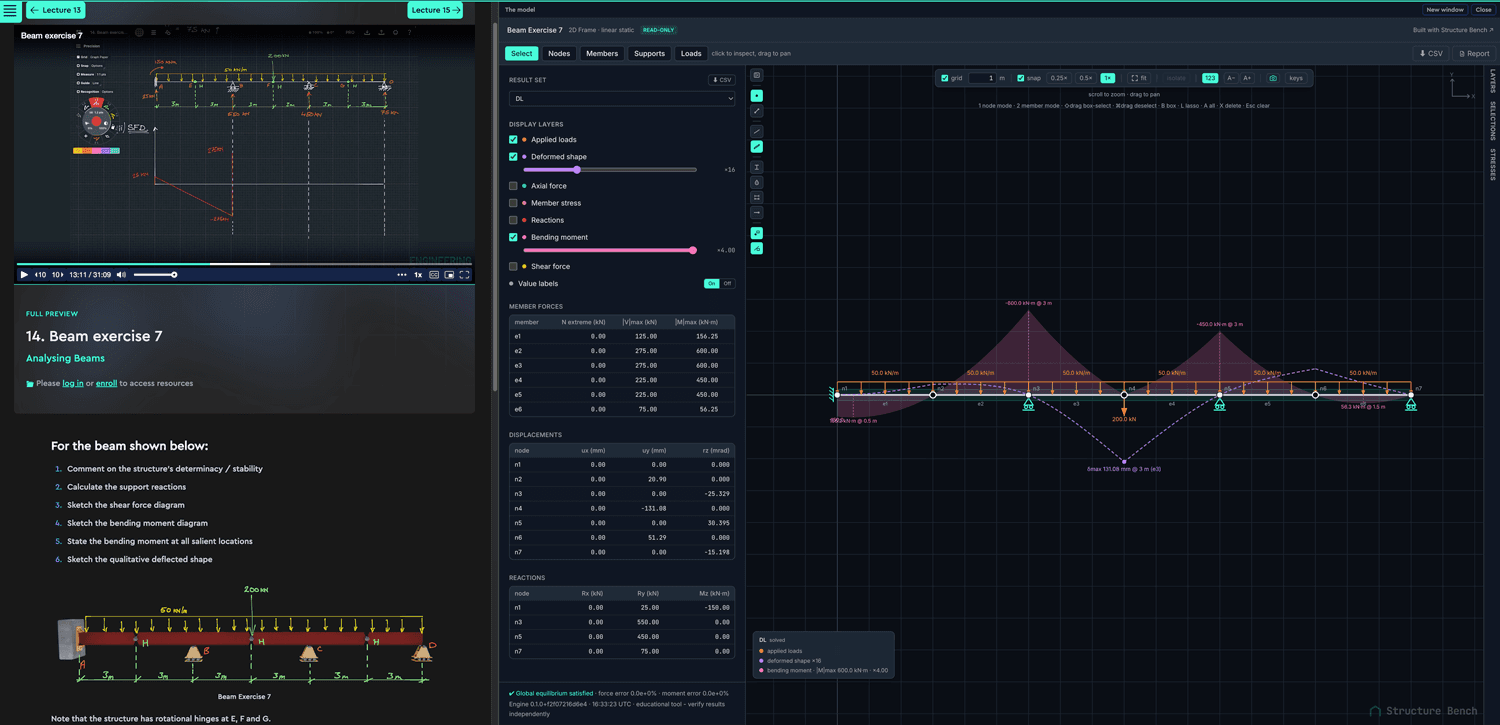
As you work through an exercise, you can reveal the results individually:
- support reactions
- axial force diagram
- shear force diagram
- bending moment diagram
- deflected shape
This allows you to check your work as you progress, without revealing the entire solution at once. Sketch your prediction, reveal the relevant result and compare the two. If they differ, take a moment to work out why before moving on. That process of predicting, checking and revising is an important part of developing your understanding.
You can also edit your own version of each exercise model or build a new model from scratch. Change a load, move a support or introduce a hinge, then predict how the behaviour will change before checking the results.
That gives you an effectively unlimited supply of practice questions, with the ability to explore the variations you find most interesting or challenging.
Whether you’re building confidence at the start of your career or returning to skills you haven’t exercised in years, the course gives you a focused opportunity to practise and the tools to keep practising long after you’ve completed the lessons.
Get notified when we launch 🚀